NINE DEPARTMENTS. ONE PARTNER.
Mapping how a new partner was onboarded, front stage and back stage, with every department that touched it, then redesigning it.
- Role:
- UX Designer. Owned the blueprint and the solution, facilitated every session, and designed the platform training
- Company:
- Intelisys, a ScanSource company
- Sector:
- B2B SaaS, telecom services distribution
- Dates:
- 2020 to 2021
THE PROBLEM
Onboarding started the day a partner signed. It ended when they finished training on MyIntelisys, the platform they would sell through.
In between, nine departments had a hand in it, among them sales, partner support, order management, commissions, and solution engineering. Each team owned its own steps. No single document showed all of them together.
A new partner felt the seams. In the first week they could receive six emails and still not know what came next. I put their question in the board's parking lot so it stayed in front of the group: who is my person, and who do I go to to get paid?
When the departments listed their pain points, they fell into four kinds:
- Communication that was too much or too little.
- Communication out of sync.
- Missing materials.
- Messages that asked nothing of the partner.
WHO WAS IN THE ROOM
Three executives sponsored the work. Marketing owned the onboarding process and set its objective. A new partner should see the value of working with Intelisys right away, without being buried in information. Every partner should get the same onboarding.
It began with two Lightning Decision Jams in August and September 2020. The group's own challenge statements asked for a process where everyone knew their part, and for training that covered onboarding from start to finish for every department. The blueprint was the answer to both.
I owned the blueprint and the solution. I introduced the method, built the board, and facilitated every session. I worked directly with marketing's subject matter expert on documenting the process. Her team validated each step with the departments. I validated it too, and questioned it.
We met one on one with the people who did the work in each department, an hour each. Then we brought everyone together two hours a week.
HOW IT RAN
We set three phases at the start.
- Discover and define, two weeks. The top of the board showed what the business delivered to the partner. The bottom showed how each department made it happen.
- Design and prototype, two weeks. We prototyped changes to the process, estimated their effect, and joined the departments' separate efforts into one process.
- Deliver and implement, two to three weeks, plus training for each department.
The board had three jobs. It was a current state record to measure later changes against. It was a map of where onboarding could improve. And it was one source of truth every department could train from.
THE MAP
The board went through eight versions between October and December 2020. Each version carried a box of what had been removed from the last.
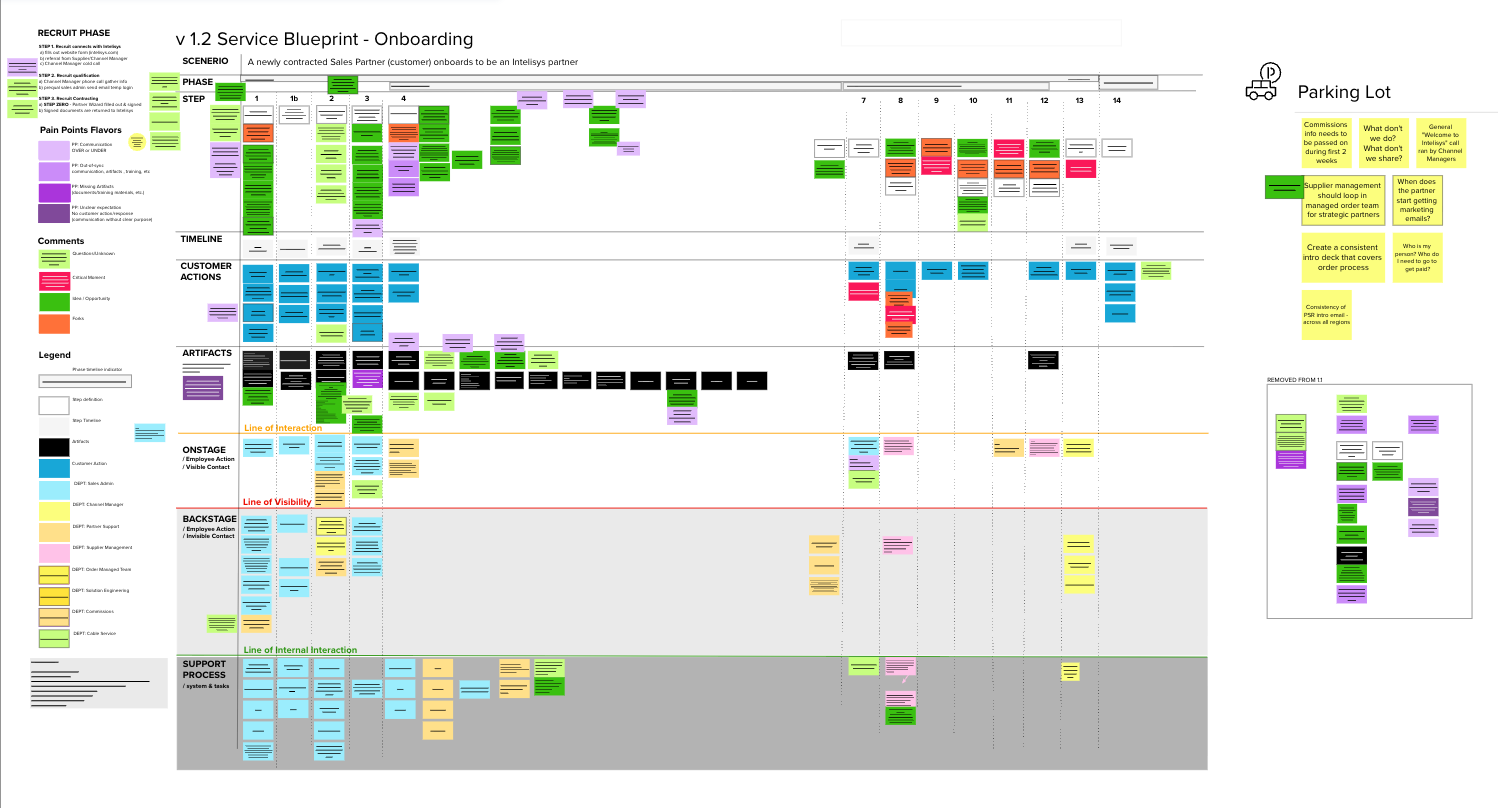
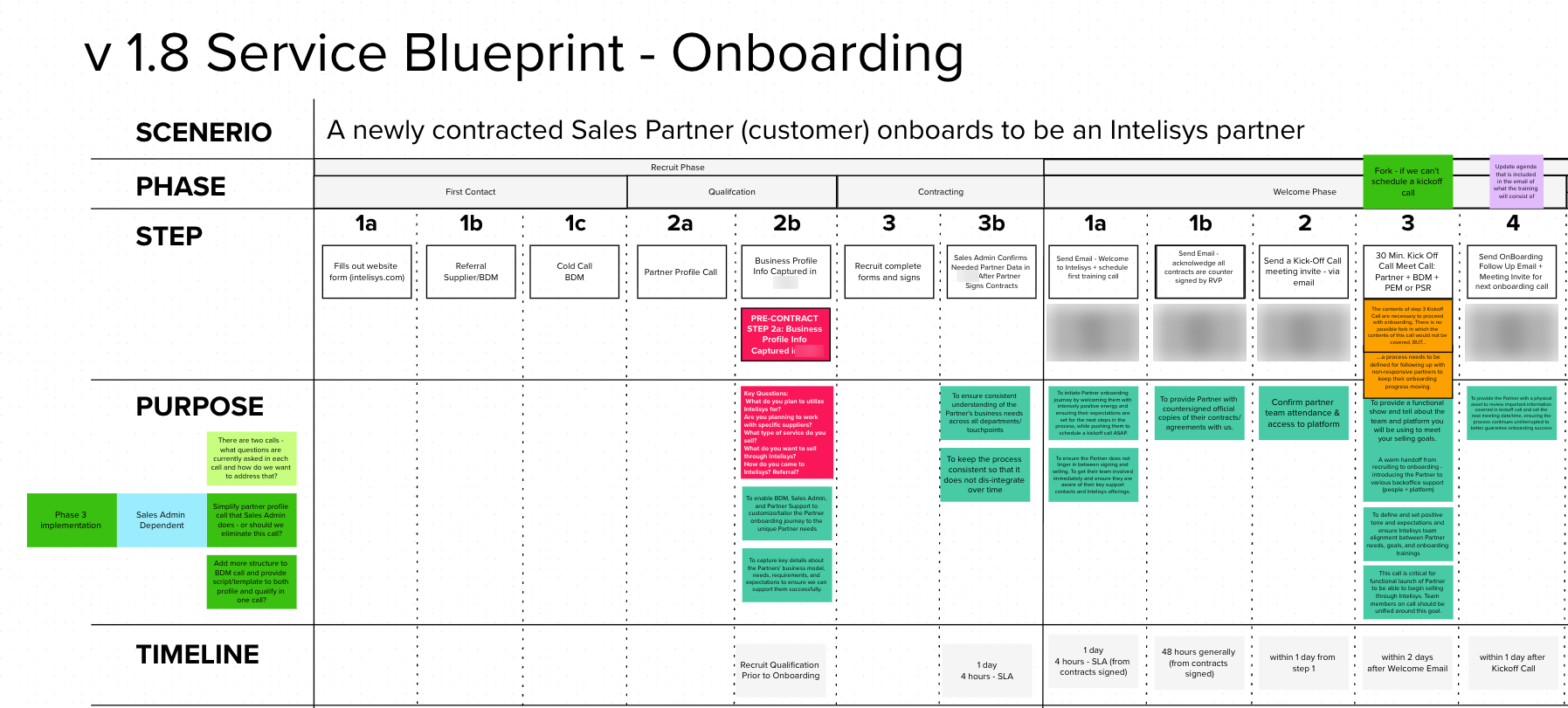
Version 1.8 ran left to right through the whole relationship:
- Recruitment: first contact, qualification, and contracting.
- A welcome phase.
- Platform training in four phases.
- Additional support services.
- A thirty day check in.
- First order.
Top to bottom it ran through these lanes:
- Each step's purpose and timing.
- What the partner did.
- The materials the partner received.
- What staff did in front of the partner.
- What staff did behind the line of visibility.
- The systems underneath.
Every note took its department's color. Every pain point was tagged by kind.
Every step also got a time standard:
- The welcome email went out within a business day of signing.
- The kickoff call came within two days of the welcome.
- A check in came thirty days after signing.
- Commissions training came when the partner made a first sale.
THE SOLUTION
Each pain point went through the same steps:
- Vote on priority.
- Propose a fix.
- Place the fix on an impact and effort scale.
- Decide.
I proposed the fixes, and the departments validated them. The result was two lists for the executives. Quick fixes with high impact and low effort went in now. Bigger ideas waited for a later round, because each was a project of its own.
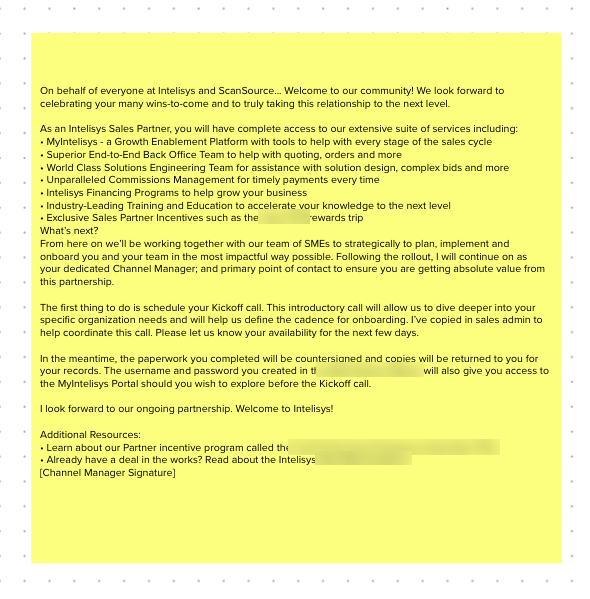
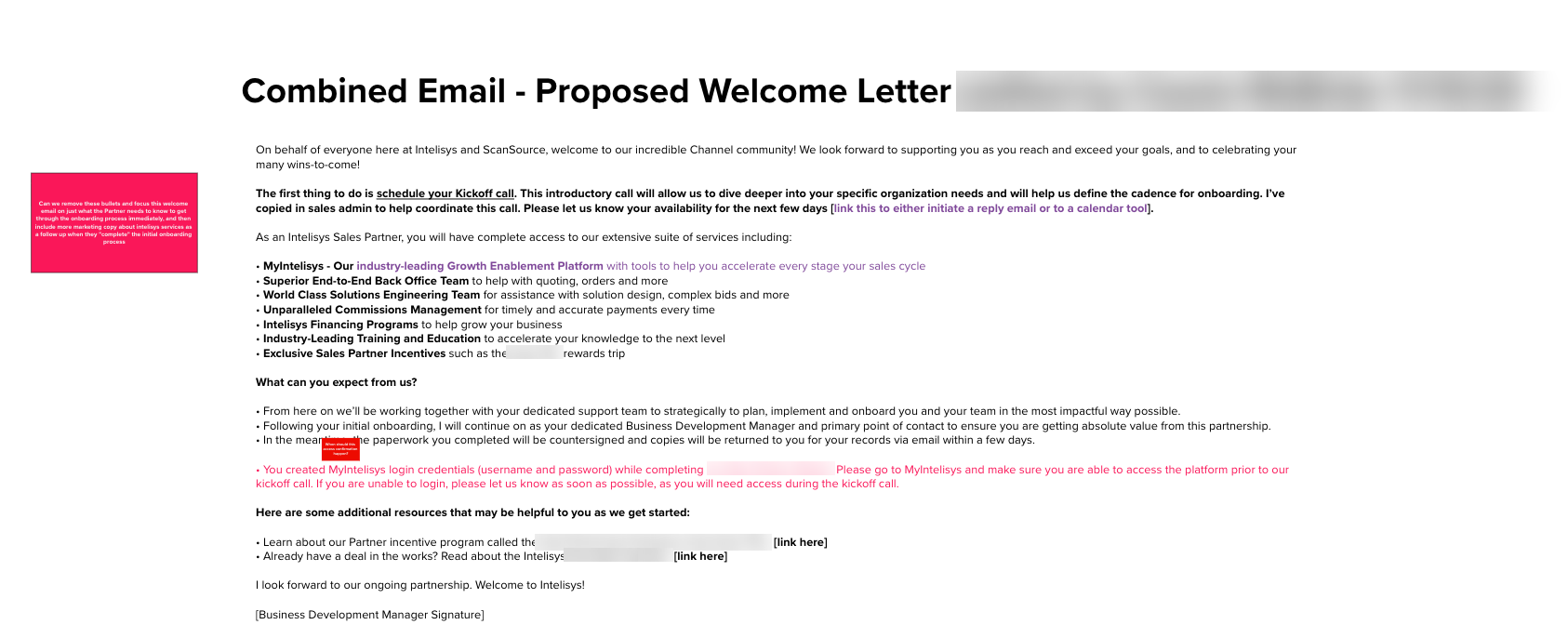
- One welcome letter, one first step. Separate welcome messages were combined into one letter. Its first instruction became "schedule your kickoff call." A separate support team intro email was taken off the task list entirely.
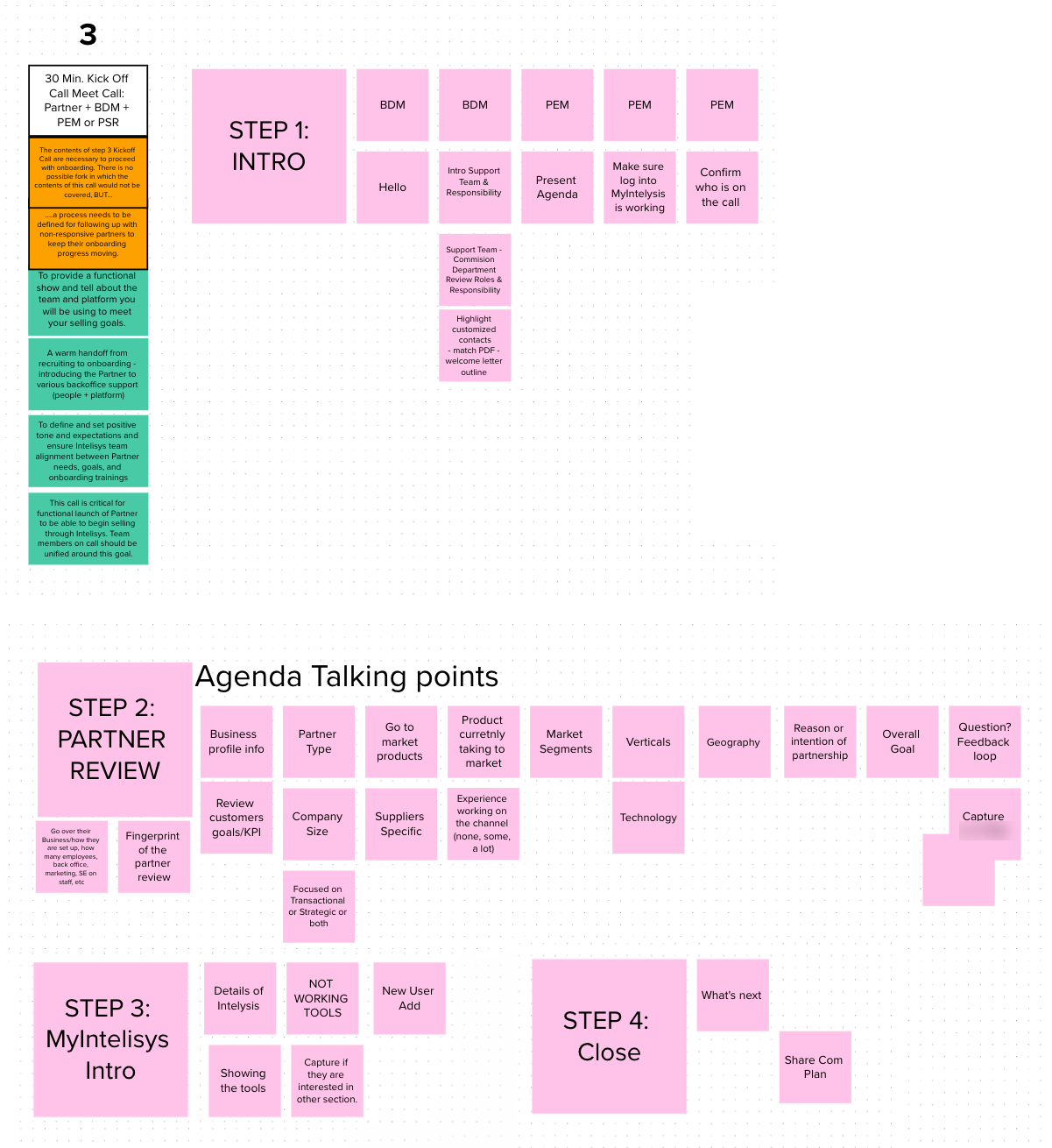
- A kickoff call that does the handoff. Thirty minutes, in four parts:
- Introductions to the support team, with a check that the partner can log in.
- A review of the partner's business: how they are set up, whether they work transactionally or strategically, their segments, their geography, and their goals.
- A tour of the platform.
- What comes next.
The board called it the warm handoff from recruiting to onboarding. The partner's channel manager led it. Each channel manager covered a partner type or a region, and the role was later renamed business development manager.
- Profiling questions asked with purpose. The questions were split by depth. Sales admin asked the simple set. The channel manager asked the deeper set from a script.
- Platform training in four phases. I designed this step.
- Functional: how to use the platform to start selling.
- Concierge: the outcomes the partner named at kickoff decided which tools to teach.
- Supplier and technology: partner driven. A webinar by default, and a solution engineer one on one when needed.
- Summary: completion recorded.
I wrote the call outlines. I ordered the tools by when a partner would reach for them, and mapped them to the stages of the partner's own sales funnel. The training followed the partner's two prime functions: selling first, then getting paid at the first order.
- Each finished step starts the next. Marking a step complete in the internal system triggered the next owner's task. A completed kickoff set up the training follow up. Completed training triggered the channel manager's follow up call. Communication went into one centralized record.
DELIVERY
The solution ended in a twelve item implementation checklist. It covered:
- A recruitment profile form.
- New business profile fields in the internal system.
- The removed intro email.
- New welcome, kickoff, and follow up templates.
- A kickoff agenda.
- Training call outlines.
- A renamed incentive program that partners had confused with another.
- A plan for keeping support teams current on the platform.
Marketing implemented the changes, with its subject matter expert validating each decision as it went in. Sales admin submitted the new steps the internal system needed. In January 2021, ownership of the running process passed to the operations leader.
All of it shipped:
- The combined welcome letter.
- The kickoff call.
- The four phase training.
- The steps that triggered one another.
WHAT CHANGED
Handoffs in a new partner's onboarding fell from roughly six to eight down to one or two. The partner met one coordinated team on one call. The steps behind that call passed work forward through the internal system rather than through the partner. Repetitive steps behind the line of visibility were isolated and changed in that system.
The relationships outlasted the project. A year later I wrote to people I had met in these sessions to recruit partners for the persona research.
REFLECTION
What surprised everyone, me included, was how much work was being done twice. Each department had been solving its part of onboarding on its own. Once the whole process was stitched together on one board, people found steps that duplicated another team's work, fixes that contradicted another team's, and loops nobody could see from inside their own department.
The map also surfaced the gray areas, the steps where the honest answer was "it depends." No one owned those decisions, and that is where much of the confusion and delay came from. Naming them is how we settled who made the call.