THE BUYER WAS NOT THE STUDENT.
Facilitating a public utility's first internal design sprint to decide who its lineworker training center served, and what it would offer them.
- Role:
- UX Specialist, contract. Workshop facilitator, project manager, researcher, and designer
- Company:
- SMUD, Sacramento Municipal Utility District
- Sector:
- Public utility, workforce training
- Dates:
- 2019
THE PROBLEM
The Sacramento Power Academy is where SMUD trains utility workers. In the summer of 2019 its public page spoke to people looking for a career in the energy industry. It listed one course, a one day introduction to pole climbing, and a set of training areas planned for later.
The Academy wanted to become a business that trained other companies' crews. It wanted to sell the courses it already had and build multimedia training that did not exist yet. Underneath the new website sat harder questions. Who was the customer? What would the Academy offer them, and at what price? How much of it could be taught online?
I was on SMUD's Design and User Experience team, and I was asked to facilitate the utility's first internal design sprint to answer them.
BEFORE THE SPRINT
I interviewed subject matter experts, reviewed the marketing research already on hand, and ran Lightning Decision Jams with stakeholders. From that I identified the primary users and the business needs, mapped the customer journey, wrote down the team's assumptions, and framed the long term goal.
THE MAP
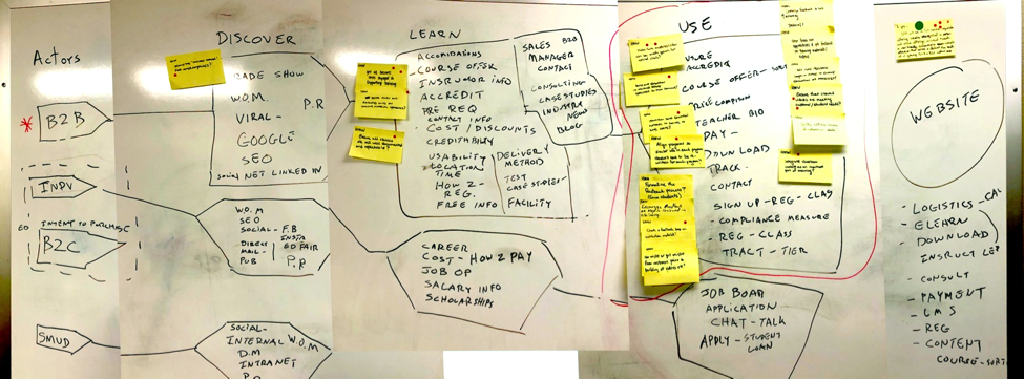
The journey map put the Academy's possible customers down the left side: businesses, individual students, and SMUD's own staff. It followed each one across three stages, discover, learn, and use. Businesses got the star.
What a business needed to learn before buying ran long: accreditation, course offerings, instructors, prerequisites, cost and discounts, location, delivery method, and case studies from other companies. What it needed to do afterward ran longer: register people for classes, pay, track their progress, and measure compliance. The individual's lane looked nothing like it. It asked about careers, salaries, scholarships, and how to apply.
That split decided the rest. A company paid for the training, and its crews sat in the classes. The person deciding to buy was not the person learning to climb the pole.
The map also set eLearning, instructor led classes, and downloads side by side as ways to deliver the training.
THE DECISION
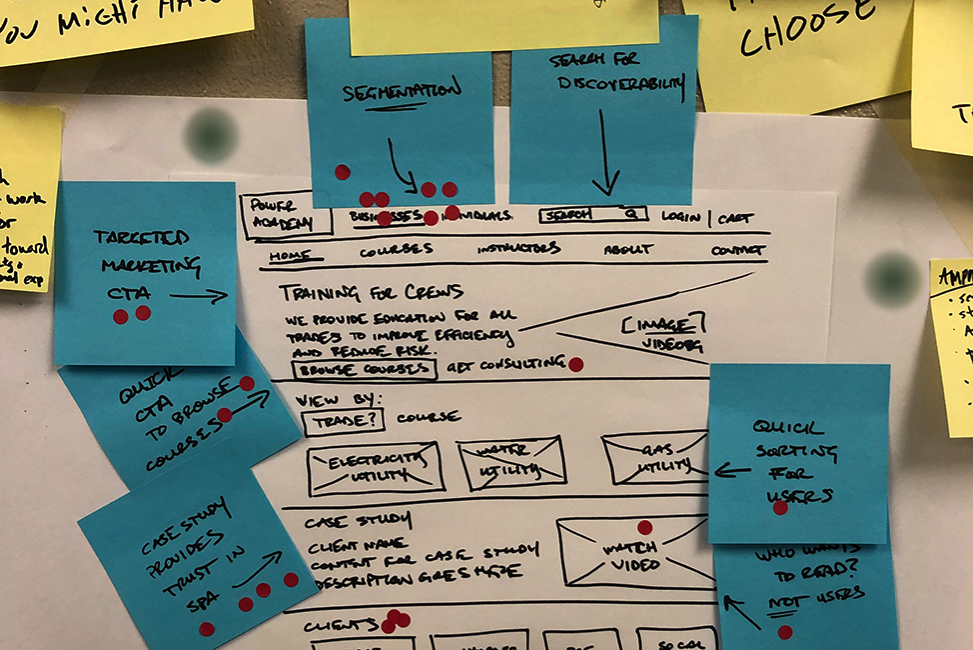
The team sketched solutions and voted with dots. Segmentation drew the most votes: one front door for businesses and one for individuals, with businesses first. Courses could be browsed by utility trade, electric, water, and gas, so a buyer could find the right training for a crew. Consulting sat beside the courses as its own service. Case studies from other companies gave a business a reason to trust the Academy with its people.
THE SPRINT
- Three days of design sprint.
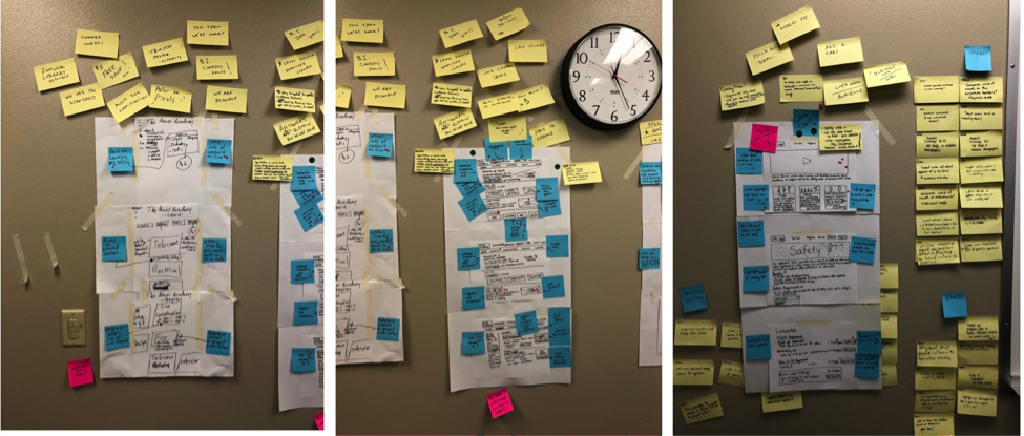
- Two days building a clickable prototype: collecting assets, writing content, and designing screens, while enrolling testers and writing the testing matrix and question script.
- Two days testing with five people, internal and external. Every session was recorded and reviewed by the team.
- One day of iteration sprint to check the results against our assumptions and set decision points.
- One day writing the report, and one day presenting to stakeholders with a production timeline.
The prototype tested our assumptions about which features mattered, pricing, the purchase flow, and what the Academy should offer.
WHAT TESTING FOUND
All five testers received the concept well. Businesses wanted a training program they could rely on to educate their employees. They read the prototype's plain design as a sign the Academy was focused on their needs, and they liked how quickly they could find a course and sign up. These are findings from five people, not a conversion rate.
WHAT SHIPPED
The findings set the functionality, content strategy, and development timeline for the new site. I stayed on through the build. I designed the UI, the style guide, and the site map, and produced redlines for the developers.
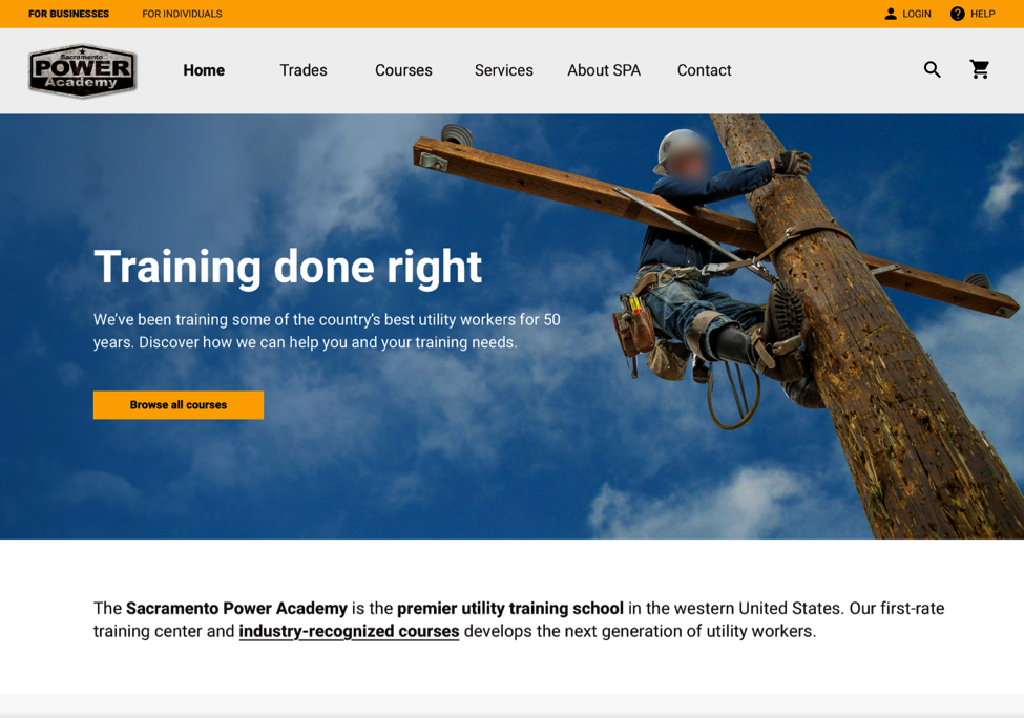
The site was reviewed internally before the end of 2019 and went public in January 2020, the deadline the Academy had set. It opened with the prototype's headline, "Training done right," and its opening paragraph word for word. A Businesses and Individuals switch sat under the hero, with trades, expert services, and a business case study below. See the January 2020 capture.
The business offering was still on the site in November 2020. The current Academy site describes training SMUD's own workforce and no longer lists it.
THE METHOD, BEFORE AND AFTER
Dallas Design Sprints, 2018
A remote workshop for an online work referral network. I facilitated it and designed the task flow, wireframes, and the prototype we tested.
Noria Wines, 2018 to 2019
A brand sprint, then a rebrand and a new ecommerce site, working with the winemaker, the business manager, and a developer.
Intelisys, 2020 to 2022
Lightning Decision Jams that opened the partner onboarding blueprint, and later ones for marketing and the development team.
Intelisys, 2026
The build or integrate session behind Contract Builder.